Dragonfly
Common Whitetail Dragonfly
Plathemis lydia · genus Plathemis
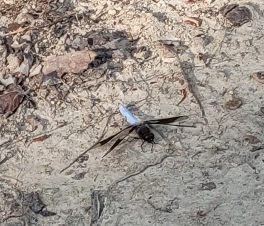
Male Common Whitetail dragonfly with a powdery-blue abdomen and dark, broad-banded wings, resting on dry ground. A beneficial aerial insect predator tied to pond, clearing, and woodland-edge habitat.
About
Description
A male Common Whitetail dragonfly (Plathemis lydia) observed resting on light-colored dry ground. Distinctive powdery-blue elongated abdomen ('whitetail'), dark brownish-black thorax and head, and outstretched wings with characteristic dark broad bands typical of the species. Order Odonata, family Libellulidae (skimmers).
Safety Cautions
Harmless to humans; beneficial predator. Avoid broad-spectrum pesticides that reduce dragonfly populations.
Not edible.
No known use.
Aerial insect predator and aquatic/terrestrial ecosystem connector. Diet includes mosquitoes, flies, midges, and other small flying insects. Life cycle runs from aquatic nymph to terrestrial/aerial adult.
Pond edges, clearings, and woodland-edge interfaces; nymphs aquatic, adults aerial.
Active late spring through early fall; most visible in warm months near water.
Pond / clearing / woodland-edge ecosystem
Pond / clearing / woodland-edge ecosystem
Permaculture value: natural insect regulation; its presence supports the picture of Portal 33's pond functioning as part of a broader insect/amphibian/wildlife system.
Confirm sex and species via close-up of wing banding pattern and abdominal coloration; document nymphs in pond edge water if possible.
Field Views
Gallery
Educational use only. Identification, edibility, and traditional medicinal knowledge is shared for learning. Always obtain positive identification before eating, harvesting, or medicinally using any plant or fungi. This Atlas is not medical advice.